
See also: Meditations for the Fifteen Mysteries of the Rosary (with pictures)
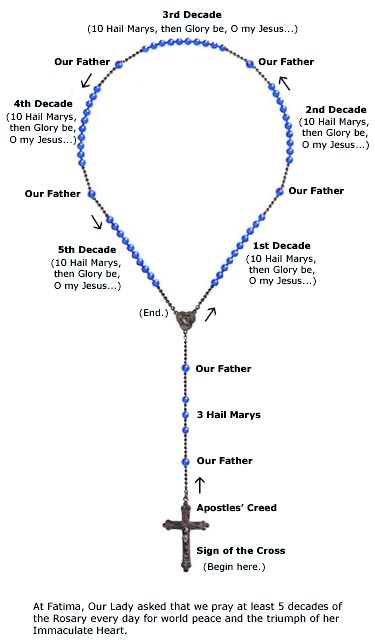 * If you do not know the prayers of the Rosary, you will find them below the Rosary Diagram.
- Holding the crucifix of the Rosary with your right hand, make the Sign of the Cross and then kiss the crucifix.
- It is good to begin your Rosary by offering it for some intention.
Example: “I offer this Rosary for all my spiritual needs and those of my family, for the conversion of sinners, in reparation for my sins and those of all sinners, for world peace and the triumph of Mary's Immaculate Heart.” - On the crucifix, pray the Apostles’ Creed.
- On the first single bead after the crucifix, pray an Our Father.
- On each of the next three beads, which are grouped together, pray a Hail Mary.
- After the three Hail Marys, pray the Glory be. Now this is where the “decades” begin.
- On the next single bead, announce the decade and then pray an Our Father. (Example: “The First Joyful Mystery, the Annunciation. Our Father, Who art...”)
- On each of the ten beads that follow, pray a Hail Mary while reflecting upon the mystery assigned to this decade (see list of mysteries below). Some people find that looking at a picture depicting each mystery helps them meditate on the mystery.
- After the ten Hail Marys, pray the “Glory be” and “O my Jesus...”
- Repeat steps 6 and 7 until you have prayed all 5 decades.
- Many Catholics also pray the “Hail Holy Queen,” the Prayer to St. Michael, and the Litany of the Blessed Virgin at the end of the Rosary. (The Litany is not listed with the prayers below, but will be available on a separate web page some time soon.)
The diagram at the right shows a five-decade Rosary such as those most commonly used by Catholics. The purpose of the beads is to keep track of the prayers, especially the sets of 10 Hail Marys. As seen in the chart, the single beads are the Our Fathers, while the group of three beads and the five groups of ten beads are the Hail Marys. As we pass each bead through our fingers, we pray the appropriate prayer, and then move to the next one. By doing this, we simply work our way around the Rosary, beginning at the Crucifix and ending at the centerpiece.